HPC MLOps Object Detection with YOLO Knowledge Distillation
Real-time traffic object detection deployment with Docker, FastAPI, Gradio, ONNX, and TensorRT
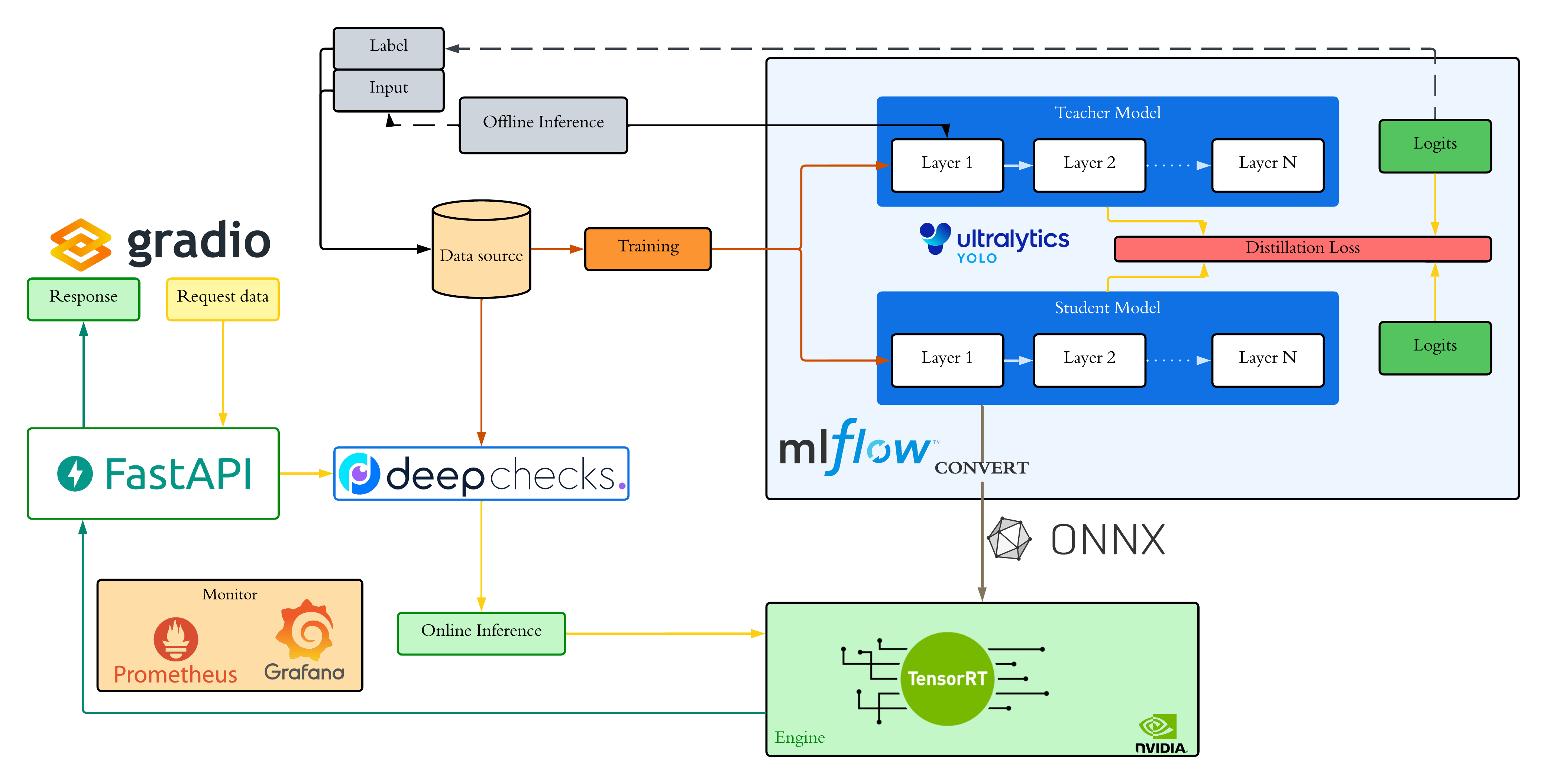
Built an HPC-oriented MLOps pipeline for real-time traffic object detection. The project trains YOLO teacher, student baseline, and student knowledge-distilled models, compares accuracy-latency trade-offs, exports optimized artifacts, serves inference with FastAPI and Gradio, and wraps the system with Docker Compose, MLflow, MinIO, and monitoring components.
Timeline
2026
Type
Project
Status
completed
My work
- •Worked on the MLOps project structure, model artifact workflow, serving pipeline, and benchmark interpretation
- •Packaged FastAPI/Gradio serving, Docker deployment path, and MLflow/MinIO tracking evidence
Outcome / Impact
- •Built a teacher-student YOLO training workflow with Knowledge Distillation for traffic object detection
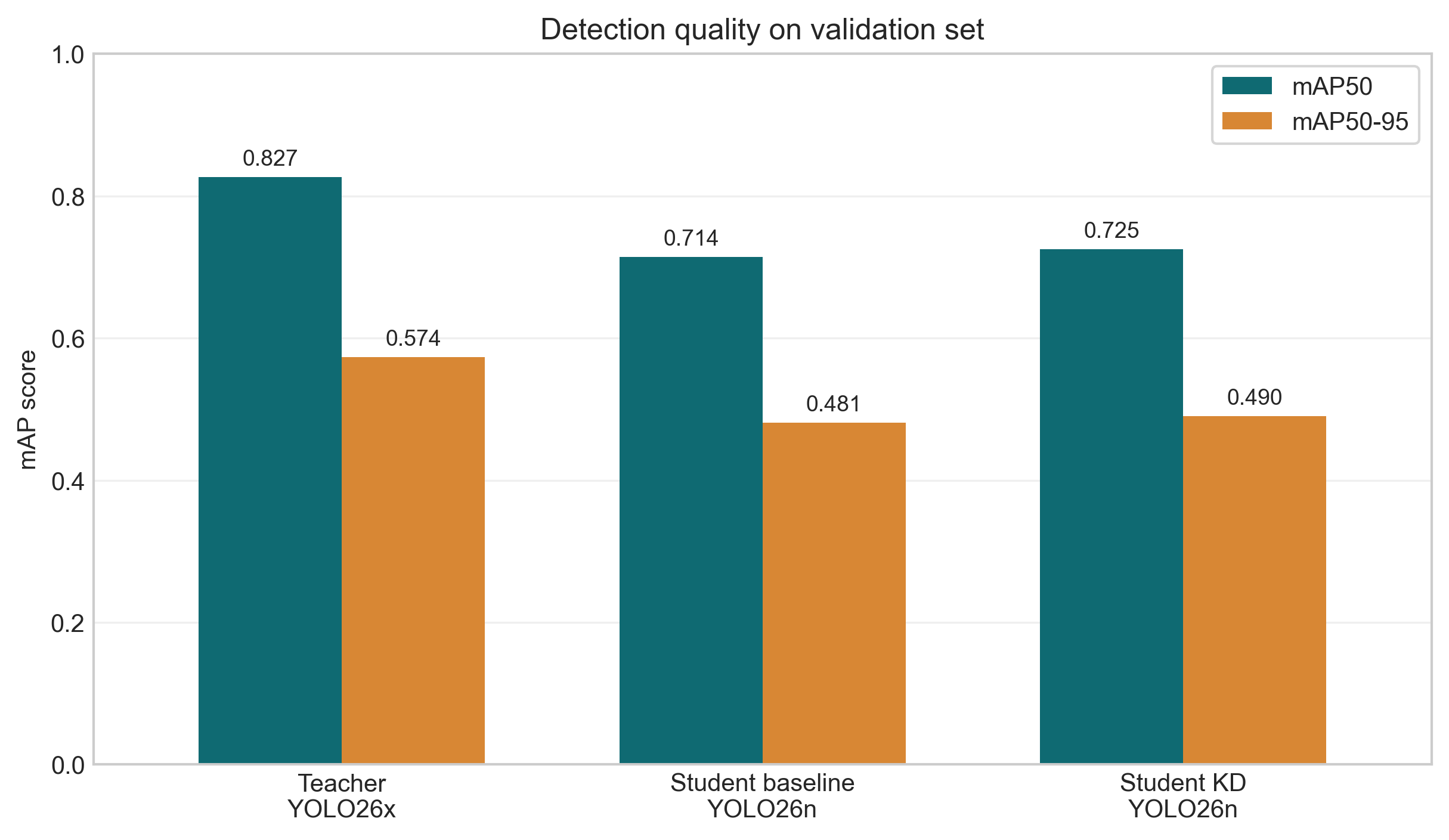
- •Student KD reached mAP50 0.725 and mAP50-95 0.490 while reducing parameters from 58.82M to 2.51M and model size from 112.85 MB to 5.14 MB
- •Benchmarked inference speed from PyTorch 9.4 ms/image to ONNX Runtime 5.1 ms/image and TensorRT FP16 1.84 ms/image on Tesla T4
- •Packaged serving with FastAPI, Gradio, Docker Compose, MLflow/MinIO tracking, and monitoring-ready infrastructure
Tech / Skills
Project Media
Demo video and visual walkthrough for this project.
Project Screenshots
Case Study
1) Context / Problem
Real-time object detection needs more than a high-accuracy model. Deployment requires fast inference, small artifacts, reproducible training, monitoring, serving APIs, and a clear trade-off between accuracy and latency.
2) Your Role
I worked on the MLOps-oriented project structure, model artifact workflow, serving pipeline, report evidence, and benchmark interpretation for teacher-student YOLO deployment.
3) Approach
Structured the pipeline into dataset preparation, teacher training, student baseline training, Knowledge Distillation, artifact export, FastAPI/Gradio serving, Dockerized deployment, and monitoring/tracking infrastructure with MLflow, MinIO, Prometheus, Grafana, Loki, and Alertmanager.
4) Result / Impact
Delivered a reproducible course project with final report, serving artifacts, Docker deployment path, model comparison figures, and quantified speedups from PyTorch to ONNX and TensorRT.
5) Learnings
Compression work is only useful when the deployment path is measured end to end. The best model for production is the one that balances mAP, latency, artifact size, and operational observability.
6) Links
See links above.